
· by Michael Blair, Nashville's Cabinets
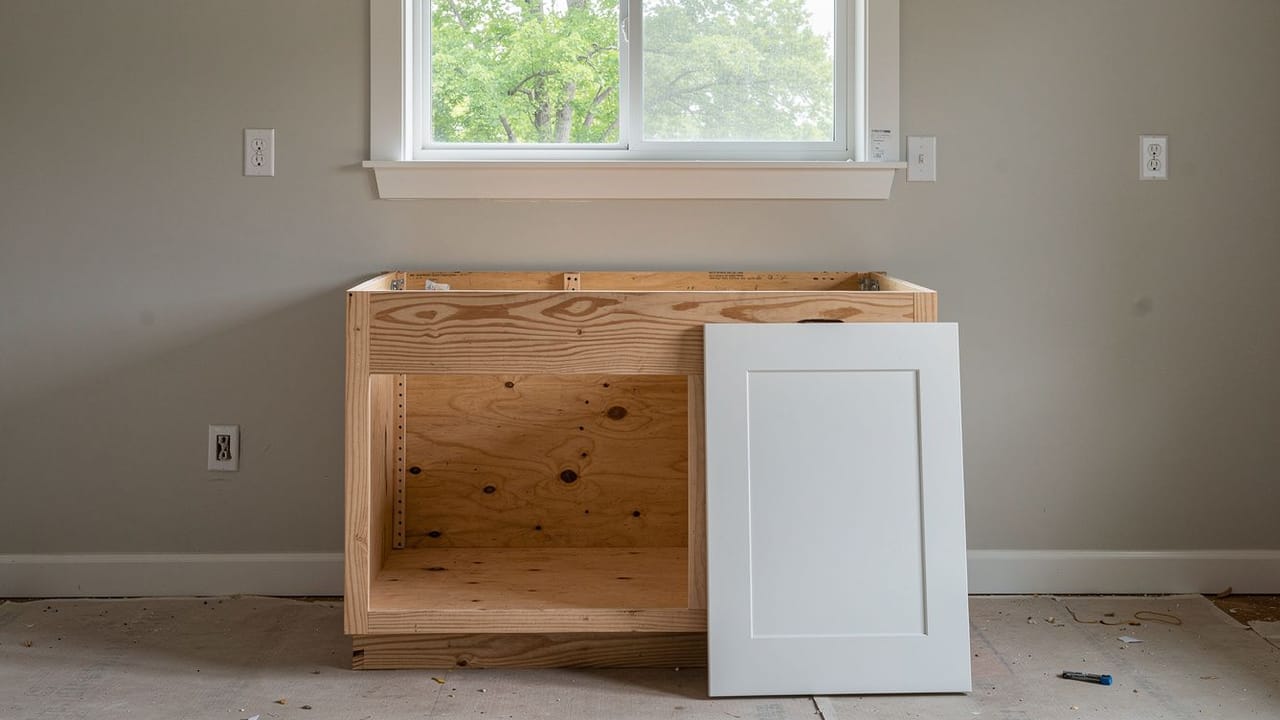
Cabinet quality is judged by the doors and decided by the boxes. Wood and wood panels trade moisture with the air around them, and the Forest Products Laboratory’s Wood Handbook chapter on moisture explains that how much depends on the relative humidity and temperature of that air and on the water already in the wood. Across most of a kitchen that means slow movement from one season to the next. Under a sink, where a drip can sit on a panel for weeks before anyone opens the door, the box material is the first thing we look at.
Which cabinet box material handles water better?
Plywood takes a wetting better than particleboard does. The Wood Handbook’s chapter on wood-based composites says plywood shows very little permanent thickness swelling when it gets wet, in contrast to most panels made from particles, and that its alternating grain resists splitting, so screws and nails can go in close to the edge of a panel. The handbook also ties water resistance to the resin in the glue line, which is a matter of the panel’s grade, so we read the maker’s specification rather than trusting the word plywood on its own. Where a cabinet line offers plywood boxes as an option, we quote the kitchen both ways.
Standard particleboard is an interior panel, and in a dry cabinet it does its job. The ANSI A208.1 particleboard standard is written for interior use and tests how much a panel grows in length as the air goes from 50 to 80 percent relative humidity. Soaked, a standard grade swells and does not come back down, which is the contrast the handbook draws with plywood. The same standard also lists moisture-resistant grades, MR10 and MR50, that may swell no more than 5.5 percent in thickness after 24 hours under water, so the grade on the spec sheet tells you more than the material name. Under a sink that is the difference that counts, and our post on repairing a water-damaged sink base shows what happens when the box loses that contest.
Do solid wood cabinet doors move with the seasons?
Solid wood doors move with the seasons. The handbook’s moisture chapter describes wood swelling as it gains moisture and shrinking as it loses it, with movement along the growth rings roughly twice that across them. The handbook’s chapter on drying and moisture control says hardwood for cabinets is usually dried to 6 to 8 percent moisture content and advises installing wood at the moisture level it will live at, which keeps the seasonal swing small. Cardell’s cabinet care guide adds that cabinets stored in a garage or basement before they go in may need time to settle to the house. On a painted door, the movement that remains can show as a thin line where the panel meets the frame, and we treat that as wood behaving like wood. How each finish copes with it is covered in our post on painted and stained cabinets.
MDF moves far less than solid wood, though it is not immune to moisture. The ANSI A208.2 standard for interior MDF caps its linear expansion between 50 and 80 percent relative humidity and sets separate moisture-resistant grades for panels that see periodic wetting. MasterBrand’s page on compound materials describes MDF as having less variability than wood species, which makes it excellent for machining and painting, and that is the reason we suggest it for painted door panels.
- Plywood, or a moisture-resistant grade, for the sink base
- MDF for painted doors, solid wood for stained
- A heat shield beside any thermofoil next to an oven or range
- Full-extension soft-close drawer runners
- Adjustable shelves at the very least
Thermofoil and heat
Thermofoil is a thin PVC film bonded with heat and pressure over a shaped MDF core, as MasterBrand describes it, and the result is one continuous skin over the face and edges of the door. Heat is its weak spot. Cardell’s care guide recommends a heat shield on the cabinets next to the appliance for thermofoil and laminate doors, notes that self-cleaning ovens give off intense heat during a cycle, and advises taking off the doors and drawers beside or directly above the appliance while that cycle runs.
We fit the shield when the cabinets go in. If a layout puts a thermofoil door tight against the range, we would rather raise it while the kitchen is still on paper, and on a custom cabinet job the oven wall can be planned around it from the start.
What to look at in a showroom
When we size up a cabinet line, we open a drawer all the way and look at the runner. We look at the back of the box to see whether it is a panel captured in a groove or a thin sheet stapled on. Then we press the middle of a shelf to feel how thick it is and whether it gives.
Those three checks say more to us about how a kitchen will age than the door finish does. If you have a quote or a sample door you would like a second opinion on, ask us for a free estimate and bring it along.
Sources
- USDA Forest Products Laboratory, Wood Handbook (2021), Chapter 4: Moisture Relations and Physical Properties of Wood — Moisture exchange depends on relative humidity, temperature and the wood’s moisture content; wood swells and shrinks; tangential movement about twice radial
- USDA Forest Products Laboratory, Wood Handbook (2010), Chapter 11: Wood-Based Composite Materials — Plywood has minimal irreversible thickness swelling when wetted, unlike most particle panels; resists splitting near edges; resin type and moisture
- USDA Forest Products Laboratory, Wood Handbook (2010), Chapter 13: Drying and Control of Moisture Content and Dimensional Changes — Cabinet hardwood usually dried to 6% to 8% moisture content; install wood at its in-service moisture content
- ANSI A208.1-2022, Particleboard (Composite Panel Association) — Interior particleboard; linear expansion measured between 50% and 80% RH; MR10 and MR50 grades limited to 5.5% thickness swell after 24-hour submersion
- ANSI A208.2-2022, Medium Density Fiberboard (MDF) for Interior Applications (Composite Panel Association) — Linear expansion limits between 50% and 80% RH; moisture-resistant grades for periodic exposure to moisture
- MasterBrand Cabinets, Compound Materials — MDF has less variability, excellent for machining and painting; thermofoil is PVC film bonded to an MDF core, covering face and edges
- Cardell Cabinetry, Care Guide (2018) — Heat shield for thermofoil and laminate doors on adjacent cabinets; remove doors near self-cleaning appliances during a cycle; acclimation after garage or basement storage
FAQ
Cabinet Materials in Nashville Humidity — questions
Are plywood cabinet boxes worth the extra?
Under the sink, we think so. Plywood swells much less than standard particleboard when it gets wet, so a slow leak does less lasting harm to the cabinet floor. Elsewhere the case is weaker if the kitchen stays dry. Plywood or a moisture-resistant particleboard grade for the sink base and other wet spots, with standard panels for the rest, is a sensible compromise.
Why are my painted cabinet doors cracking at the joints?
If the doors are solid wood with a separate center panel, the likely cause is seasonal movement. Wood swells as it takes on moisture and shrinks as it dries, and paint spread across the joint between parts that move can open a fine line there. MDF panels move far less than solid wood, which is one reason they are used for painted doors. A crack that keeps widening, or a panel that rattles, is worth having looked at.
Is thermofoil a bad choice?
Not in itself. It gives a smooth, uniform surface that wraps the face and edges of the door in one piece. Its weakness is heat: Cardell’s care guide recommends a heat shield on thermofoil doors next to an oven or range, and taking off the doors beside or above a self-cleaning oven while it runs its cycle. If you choose it, fit the shield and expect the doors closest to the heat to need attention first.
What is the difference between paint-grade and stain-grade cabinets?
It comes down to the door material. For painted doors we suggest MDF, which moves far less than solid wood and machines and paints cleanly, so there is less movement to open a line at a joint. Stained doors are solid wood, where the grain is the point, and they swell and shrink a little with the seasons.