
· by Michael Blair, Nashville's Cabinets
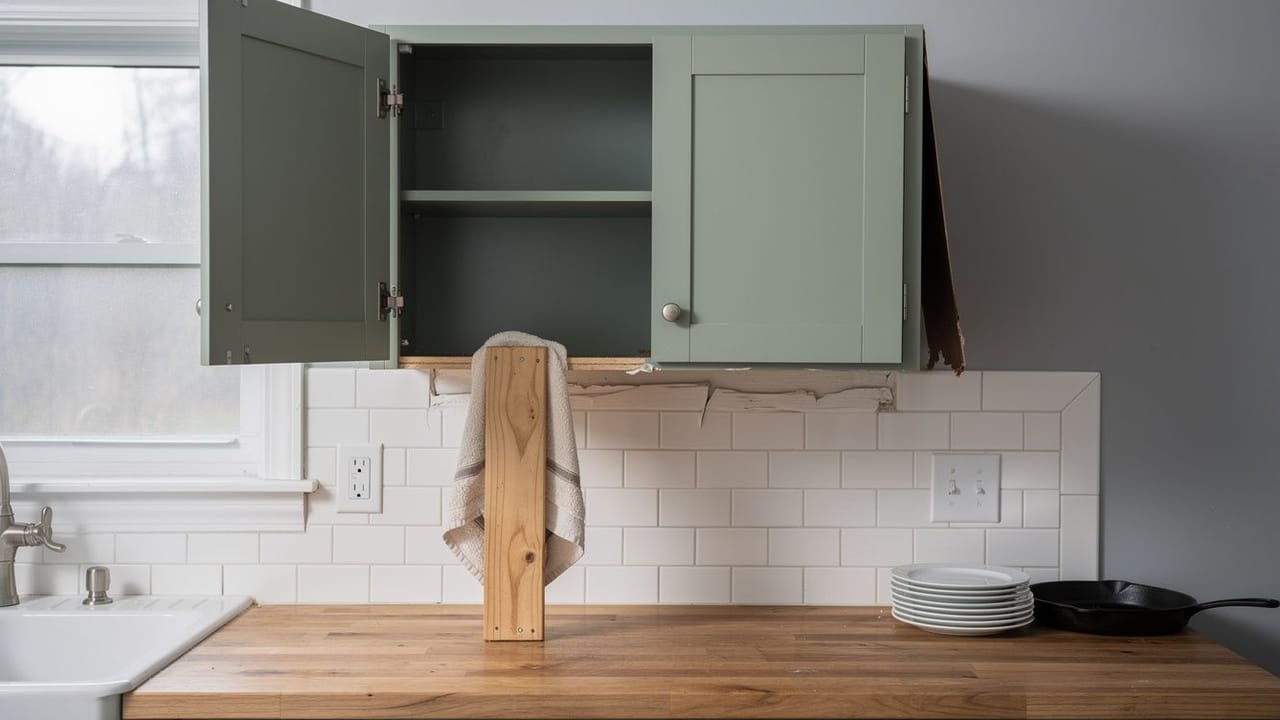
A thin dark line shows up along the top of a wall cabinet where it meets the wall. Or the caulk between the cabinet bottom and the backsplash splits, and the doors on that run start to rub. When the gap is wider at the top than at the bottom, we treat it as a cabinet leaning off its top screws, and that makes it one of the few cabinet problems about safety rather than looks. American Woodmark’s cabinet installation guide warns that cabinets which are not properly secured can fall and cause serious injury or death, and it notes that even an empty one may be too heavy for one person to lift safely.
How is a wall cabinet held up?
There are two hanging rails across the back of a wall cabinet, one at the top and one at the bottom, and the American Woodmark guide has the installer drill through both at every stud and drive the screws into the studs behind. Those screws carry the whole load: the box, the doors and everything on the shelves. The countertop is not under it and the backsplash does not prop it up. For a wall cabinet wider than 15 inches, the same guide calls for at least four installation screws, each going at least an inch into the stud.
A run of cabinets is also clamped and screwed together through the face frames, so when one box loses its hold on the wall, the neighbors it is screwed to can take some of its weight. That can hide the trouble, and it means the gap may show on one cabinet while the screws that gave up belong to the next one over. We check the cabinets on either side of a gap, not only the one where it shows.
Why do wall cabinets pull away from the wall?
Most of what we find comes back to the studs. The installation guide says to attach cabinets only to the center of wall studs, but a cabinet’s edges do not always land on one, and that is where an installer in a hurry drives the end screws into drywall with plastic anchors or with nothing at all. Nails and drywall screws are the other shortcut, and the guide rules out both because they may fail to secure the cabinet. The screw it specifies for the wall is a #10 by 2½-inch pan head. It also warns that pulling the back rails tight against a crooked wall without shims can break the joints between the rail and the body of the cabinet, which can bring the cabinet off the wall.
In older houses around Nashville the wall may be plaster on wood lath rather than drywall over studs, and that guide covers wood stud construction only; for any other wall it says to have an installation professional choose the fasteners. And sometimes it is the wall that moved. Some clay soils swell, and the U.S. Geological Survey has published a swelling clays map of the conterminous United States showing where they occur. We do not blame the soil without other signs, though. When a gap opens alongside fresh cracks above a doorway, or doors elsewhere in the house that have started to stick, we want someone who looks at structure to see it before we touch the cabinet.
- End screws into drywall or anchors instead of studs
- Nails or drywall screws where cabinet screws belonged
- Back rails cinched against a crooked wall with no shims
- A wide box hung on fewer than four screws and loaded with stoneware, cast iron and stacked plates
- Framing or foundation movement, with cracks or sticking doors elsewhere to show it
What should you do the day you notice the gap?
Empty the cabinet, and the ones on either side of it. Do not push it back to the wall and drive a few longer screws through the old holes. It feels like a repair, but unless those screws reach the center of a stud, the cabinet is still hanging from the same drywall or stripped wood. And do not climb onto the counter underneath it to get a closer look.
If it is visibly tipping, prop it from below with a padded board or a length of lumber wedged between the countertop and the cabinet bottom until it can come down properly, much like the propping stick or T-brace installers use to hold a wall cabinet in place while they fasten it. A leaning cabinet with a range hood or an over-the-range microwave under it deserves attention sooner. The installation guide leaves appliance mounting to the appliance maker’s own instructions, so before anything comes down we find out whether that unit is fastened to the cabinet above it.
How it is rehung
The cabinet comes down and the framing behind it is located properly: a stud finder first, then a small finish nail driven where the cabinet will hide the hole, which is how the American Woodmark guide has installers confirm a stud. Damaged drywall is patched. A level support rail, which the guide calls a cleat or ledger board, is screwed into the studs to carry the box while it is fastened and taken off afterward. Where the studs do not fall where the cabinet needs them and the wall is open, we add wood blocking between them so there is solid wood behind every screw, a step the guide does not cover because it assumes screws into stud centers. The box goes back up level, shimmed where the wall is out, and fastened through its rails with cabinet screws, left short of fully tight until every cabinet on the run is shimmed and in position.
The rest of the run gets checked while it is empty, since whoever hung this cabinet probably hung its neighbors the same way. Doors are adjusted afterward with the screws on their hinges, and our post on doors that sag, rub or will not close walks through which screw does what. If the house itself is moving, we would rather a foundation contractor or structural engineer look first, because a cabinet rehung on a wall that is still shifting can open up again. Hanging wall cabinets the way their maker specifies is part of how we install the semi-custom and stock lines we fit, and if you have a gap opening now, ask us for a free estimate and we will come look at it.
Sources
- American Woodmark Corporation, Cabinet Installation Guide (2021) — Falling-cabinet injury warning; too heavy for one person; two hanging rails drilled at each stud; at least four screws at least 1 inch into studs on cabinets over 15 inches wide; stud centers only; no nails or drywall screws; #10 x 2 1/2 inch pan head wall screws; rails tightened without shims can break; wood stud construction only; finish nail to confirm a stud; support rail or ledger; propping stick or T-brace; shim and do not fully tighten until positioned; appliances per their maker; hinge adjustment
- U.S. Geological Survey, Swelling clays map of the conterminous United States (IMAP 1940, 1989) — National map of swelling clay soils
FAQ
Upper Cabinets Pulling Away From the Wall — questions
Is a gap between my kitchen cabinet and the wall dangerous?
It can be. A gap wider at the top than the bottom suggests the cabinet is leaning off its top fasteners, and cabinet makers warn that a wall cabinet that is not properly secured can fall and cause serious injury. Empty it and have it looked at rather than waiting to see if it gets worse.
Can I just add longer screws to a cabinet pulling away from the wall?
Only if the new screws go through the cabinet’s hanging rails into the center of a stud, or into blocking added behind the wall. Longer screws in the same drywall holes are still held by drywall. The repair we trust is to take the cabinet down, find the framing and rehang it.
What screws should wall cabinets be hung with?
The screws the cabinet maker specifies, driven through the hanging rails into studs. American Woodmark’s installation guide calls for #10 by 2½-inch pan head screws, at least four on a wall cabinet wider than 15 inches, each reaching at least an inch into the stud, and it rules out nails and drywall screws.
How do you fix a cabinet pulling away from the wall?
Take it down rather than pushing it back. We find the studs, patch damaged drywall and screw a temporary ledger to the studs to carry the box. Where no stud falls behind a screw and the wall is open, we add blocking. The cabinet goes back up level and shimmed, fastened through both hanging rails with cabinet screws.